2004-4
AFFSblog P-Debian P-Lisp Advogato
dc iDunno Gordon J john MartynD paulr TC thom
MJR's slef-reflection
 This section is
something like a blog. You can subscribe to RSS 1.0 feeds of the entire
thing, just hacking or just scheme. The
scheme feed will be the base for the new SWN once ready.
This section is
something like a blog. You can subscribe to RSS 1.0 feeds of the entire
thing, just hacking or just scheme. The
scheme feed will be the base for the new SWN once ready.
To contact me, email mjr AT dsl dot pipex dot com.
lj revenge again
MJ Ray <mjr@dsl.pipex.com>
Dear Brett, the reason planet ALUG has all of two people's entries at the top is because lj gave the appearance of deleting all their posts for one update while I was away and I don't have time to deal with that level of buggyness (or is it bugginess?) right now. I know you'll ask, so I'm writing you this reply first. Other fixes will come sooner. MJR.
2004-05-10T01:52:22
Koha Turkey
MJ Ray <mjr@dsl.pipex.com>
Zeki Celikbas is presenting koha at Ankara's Linux festival.
2004-05-10T00:56:27
The Irish MS-EU Presidency?
MJ Ray <mjr@dsl.pipex.com>
So, the Irish EU Presidency which just oversaw the thrust towards swpat in defiance of parliament is sponsored by.... Microsoft. I was only surprised that SCO weren't listed there too.
2004-05-08T03:24:07
Ču advokatoj de homaj rajtoj?
MJ Ray <mjr@dsl.pipex.com>
"Ĵurnalistoj en plej vasta senco estas advokatoj de homaj rajtoj, gardantaj justefon kaj liberecon de l'individuoj same kiel de socio." Junger kaj Maul, Manlibro pri Ĵurnalismo. Eble tio klarigas kial britaj ĵurnaloj estas malĝojigantaj. Ili ne advokas de homaj rajtoj, kaj vokas "ne" pri asiloj kaj priveco - bazaj homaj rajtoj.
2004-05-08T02:01:24
Friday is Bond film night
MJ Ray <mjr@dsl.pipex.com>
I am writing this while watching the final part of "You Only Live Twice" on mbc2. I'm surprised how watchable films are with subtitles. There are more recent films on here, including many shown on UK channels we don't have because they're Murdoch-pay-tv or just don't serve here (channel 5). Very useful.
2004-05-07T19:31:00
New Acronym: T.W.A.T.
MJ Ray <mjr@dsl.pipex.com>
Alex just mentioned The War Against Terrorism and abbreviated it to T.W.A.T. which seems an entirely fair way to describe the paranoia being spread about it and the removals of freedom "to protect our freedom". (I can't link directly to the entry because the permalink seems broken.)
2004-05-07T10:27:09
One less One is Zero?
MJ Ray <mjr@dsl.pipex.com>
Previously, I commented in mine and in Ross's blog what a dumb name was. On the tv news at lunchtime, it announced that One will no longer use its name in service announcements. Those are the loudspeaker ones that go something like "The time, operator service to destination calling at places is on platform number." Apparently "the eight-twenty One West Anglia service" caused confusion about what time the train was, given the previous operator was called West Anglia Great Northern and the line is still called West Anglia. It would be funny, except this rebranding folly comes from our fares.
2004-05-05T15:08:58
I like IRC stories
MJ Ray <mjr@dsl.pipex.com>
Spotted Fedora as IRC on teknofile's advogato diary. I suppose you could guess I'd like that, as the IRC intro to Arch is a favourite link of mine just now.
2004-05-05T11:44:58
BBC - cluebat effective?
MJ Ray <mjr@dsl.pipex.com>
I've not been reading news for a few days. Someone posted that the BBC News Sasser article seemed to give the impression that all computers could be infected by it. By the time I looked at it, it was quite clear that only certain Windows was vulnerable. I guess they fixed it already. What a power GNU/Linux and Mac users with cluebats have sometimes.
2004-05-05T11:15:24
ALUG is 5
MJ Ray <mjr@dsl.pipex.com>
Remote blogging this from alug's 5th birthday in a Norwich pub. Good crowd turned out. I think we have 5 of those at the original meeting, which is quite good I guess, given we're 50 miles away from the place that was.
2004-05-02T19:01:06
Death by Dictionary
MJ Ray <mjr@dsl.pipex.com>
It's late and I've travelled a lot in the last two days. I've been not entirely productive IMO. To make matters worse, this note is not properly researched, so may be annoyingly vague, or just plain wrong.
I returned home to many hundreds of email, with the largest contribution coming from the debian SC tidy-up GR fall-out. From what I have read so far, some feel the new wording prevents their own interpretation of DFSG as only applying to programs. They have started playing with dictionaries and rule books and causing trouble. Someone once mentioned being able to suffocate any group with its own rule book (I warned you: not properly researched). It seems likely to perpetuate the problem, because the emergence and persistance of a minority interpretation was part of the motivation for this GR, as I understand it.
What are they aiming to get? To show debian that the voters were unrepresentative? Well, they could just try to revisit the vote now. Maybe it's to drum up support for their view first? More darkly, maybe it's to cripple debian, because we have this element who don't agree with the majority view of the SC/DFSG and have been able to become DDs without agreeing with it, thanks to elegant games with dictionaries, or just by joining long enough ago.
I wonder where we go from here. The current RM has posted that he can't see debian reaching a releaseable state any time soon. Debian has had problems for a while with slow release cycle, as far as users I talk to are concerned. Will delaying releases put people off using GRs, or are releases already so far away that proposers won't care?
Someone who has been working with debian for far too long said to me that GRs are usually a mistake. Well, we're not doing well recently, for sure. Are too many GRs "back me or smack me" types? Is the process now too automatic and cookie-cutter?
A significant number of the minority are GNU FDL supporters (OK, if that's not just totemic) or FDL-problem-deniers (hopefully not many of those) or FDL- wait-and-sees (more of those). Ultimately, FDL surely cannot be in debian. I'm surprised it's liked by GNU: "We can't depend for the long run on distinguishing one bitstream from another in order to figure out which rules apply." So says Eben Moglen, FSF's general counsel, in Free Software and the Death of Copyright. Amusingly, the article opens by giving the meaning of the word "software" (although it then quickly moves to the "software"="programs" bitstream- distinguishing weakness).
I think you can add "unfocused" to "vague" and "under-researched" about this note. Sleep well, if you're not already. (By the way, this isn't an email because I don't care about direct replies to points. If it makes you think, do something. If I've really factually goofed, I'd love an email. If you just think my opinion sucks, go find Branden's cup.)
2004-04-28T02:30:57
For Sale
MJ Ray <mjr@dsl.pipex.com>
- Alcatel Speedtouch USB, the one which works with these drivers and some coaxing.
- Belkin 4/5-socket router, model F5D230u4, with PSU.
Email me at mjr at dsl .pipex.com, as usual. I expect these will go quick, as they're better than what I usually grab.
2004-04-22T17:02:52
It would be funny if...
MJ Ray <mjr@dsl.pipex.com>
...the company parodied here wasn't an apparently successful competitor for web development work in my locality. That sort of thing and the people who put up "You must get with the Flash revolution" pages are the reason most of my work is indirectly net-based.
Dead impressed with the copy of Linux Magazine thrust into my hands at the Linux User show yesterday. It's quite a bit better than I remember and they have a trial offer on, so I may do that, depending how much privacy invasion is involved. I wonder if not being badge-scanned at the show will reduce the junk mail from them? With the bizarre details combo, it should be easy enough to spot.
Another good thing about the show was the way I saw lots of good people, but also very few bad ones who annoy me. Only two in the whole day. I wonder if they will read this? Probably not.
2004-04-22T03:15:02
LUDEXcrous Speed
MJ Ray <mjr@dsl.pipex.com>
Back from LUDEx. After delivering a box of leaflets, paperwork and badges to AFFS (or rather Debian to look after until anyone showed up for the AFFS stand), I did exactly what I wanted. That is the first show in 3 or 4 years that I did that. So what did I want? To meet people and discuss projects. I had hired a hall nearby and some hackers with projects turned up, but half of it seemed to be Hants LUGgers who turned up with no kit and sat down, all together. A bit odd, but nice to meet them. They did help cure a new problem on the laptop (mtab not a symlink to /proc/mounts, which apparently it should be, so no ptys and no X terminals), but they also calculated the terminal velocity of dropping the laptop from the nearby tower block. Then to a pub for a couple of hours and back here by a roundabout route. More later as I remember it.
2004-04-21T04:01:57
MaBloss Schycyroll breakages
MJ Ray <mjr@dsl.pipex.com>
It seems I broke mb-advo (the advogato tool) in mabloss 1.1.2. Damn. No blogging on advogato for a while. If I switch schcyroll from using the xml parser that comes with mzscheme to ssax then I can handle namespaces better and also use htmlprag to handle broken/old html in entries. Probably worth doing, but not now.
2004-04-19T13:55:30
More hardware fun
MJ Ray <mjr@dsl.pipex.com>
Quickly, because I'm working really:
- Thanks for the suggestions that "probe all LUNs" needed switching on in kernel config to cure the problem with the SCSI chain. I've compiled it in and I'll test it some time.
- Apparently, there are good 802.11a/b/g wireless cards (thanks Kinnison)
- cdrecord not only craps out trying to burn a CD in the DVD burner, it prints an advert for cdrecord-prodvd too. Yeah, great advert(!) Fortunately, growisofs works amazingly well and is far easier than cdrecord is for CDs. Anyone know if it can burn CDs too?
- So, I moved a CD burner from pipe to bouncing too. Without meaning it, bouncing is gathering most of the hardware. pipe now only is unique by having a fax modem connected. All else is available on bouncing too.
- I have a 5 CD (or 1 DVD) set of CRAN which I made for a request. If someone else in the UK wants one, email me.
- iDunno is a very good bughunter, but you have to wonder why he finds some of them.
- German translation for koha was posted to list. I'm not sure who's coordinating translations. Maybe no-one is. I'll ask for someone if no-one shouts soon. Probably exceeding my powers as 2.0 RM, but he who does wins.
2004-04-19T13:38:47
Misleading Error Messages
MJ Ray <mjr@dsl.pipex.com>
Finally, I think I have all the hardware here online. I'm not sure why the USB-SCSI adapter only sees one device at a time, but I've not yet wanted to use both the removeable disk and the scanner at once, so I'll probably look into that sometime never.
Moving the big disk from pipe (whose BIOS objected strenuously) to bouncing (who has the DVD burner anyway) was a whole world of fun. After connecting the cables, the BIOS announced that the DVD burner was not an ATAPI compatible drive. WTF? It worked before! Some investigation revealed that I'd knocked the secondary IDE cable out while fitting the big disk. Why can't the error just say that nothing was connected to the secondary IDE? Gah.
I've noticed a couple of people posting about how awkward Linux 802.11b/g wireless networking can be. I've grumbled to the person who directed me to buy certain cards because they don't work perfectly, but they were fairly simple to get connected and transferring data, without any of the linux-wlan-ng problems others report. Maybe I should thank him for his advice after all.
2004-04-18T16:44:25
Want to Hack in London next Tuesday?
MJ Ray <mjr@dsl.pipex.com>
If you're going to be near the LUDEx next week and would like to spend an hour in the afternoon hacking fun free software stuff, please email me off-list and ask.
2004-04-15T17:11:01
Pondering imponderables
MJ Ray <mjr@dsl.pipex.com>
I need to decide whether I want to keep or drop my current personal domain, towers.org.uk. Another domain is more fun for me now.
Uploaded the planets and changed their URLs within a day. Fun.
I need to decide what hardware here will do which tasks in the future.
Today is a good day.
2004-04-15T12:30:25
Occam on music
MJ Ray <mjr@dsl.pipex.com>
You know what they say about the simplest explanation often being right? Well, despite my [musings on music](http://mjr.towers.org.uk/blog/2004-4.html
copyright-and-hacking), I agree more with a newsgroup comment: "people aren't
buying as many music CDs because they aren't as good". Of course, the publishers aren't going to blame their own crap judgement for falling sales, but it does seem to be the simplest explanation.
2004-04-14T20:43:30
An afternoon in Denver
MJ Ray <mjr@dsl.pipex.com>
One fun thing about East Anglia is all the place names which people mistake for somewhere else. Most common is people not realising that part of Lincolnshire is Holland, but today I visited another one that confuses people: Denver.
Denver Windmill is an interesting place to visit and produces great flour for baking. ("Very fine flour" but that's ambiguous.) It looks cycle-able from Downham Market station without too much trouble if you have the time. Denver train station is disused, but the platforms still seem to be there, overgrown and a sad sight.
Nearby is the Denver Complex (unofficial link because Fens Waterways are flash-loving idiots and their site doesn't have a description of Denver on it once you evade the sniffer anyway). Some of the info boards have the same old stories about the cuts and peat shrinking as the land was drained, which is why the river is higher than the land in places and why parts of the fens are below sea level. Others told new things to me, like: the relief channel can flow in either direction, draining the South Level to the Wash, or diverting water to supply South Essex via pipelines from Suffolk.
On the way back, stopped at the Hare Arms, where a peacock or parakeet or something squaking nearly made me die of shock.
2004-04-13T22:51:50
planet-forming
MJ Ray <mjr@dsl.pipex.com>
So far, I have Planets building locally for AFFS, ALUG, the town where I live and some of my friends who don't appear on any of the sites I routinely read. The town one threw up a new bug: Local-News html-escapes and then URL- encodes the link tag in its RSS. I'm going to have to read the spec on that one, but I've hacked it in for now, as per "be liberal in what you accept".
SCSI is no fun. So far, the SCSI adapter only recognises the first device. I'm not sure whether they're both terminating devices. I'll try some more experiments, but it's slow because getting it wrong hangs the SCSI subsystem until the next reboot.
I want to rearrange the hardware in here. All (well, many of) the devices are on the wrong machines. I need a secure networked filesystem, print service and scanning (wireless in use). Time to investigate nfs v4 and some others, but I suspect hacking ssh into use may happen again.
2004-04-12T19:30:22
schycyroll and missing dates
MJ Ray <mjr@dsl.pipex.com>
I have a working schycyroll running locally, updating pages from local mirrors of RSS files. I still run it by hand, until I'm happy I've caught most of the deaths from evil invalid RSS files.
For some reason I don't understand, it doesn't like livejournal's html. I can understand it not liking advogato's old html4, but even when the lj looks like xhtml, it's refusing to parse it. I'll look at that Real Soon Now.
I had trouble with feeds that have no/invalid date stamps. If the date stamp is invalid, the mabloss library makes a new date stamp. As a result, all entries without a good stamp got a new stamp on each run, which wasn't the desired effect. My current solution is only to update the description of existing entries from the RSS, but I'm sure that will bite me later.
I guess I should look at planet and spycyroll to see what I can learn from them, now that I have a basic design based on the set theory I posted earlier. I wonder how they handle these problems and what other problems I still need to handle. From a quick glance, spycyroll doesn't seem to handle a basic problem: when do you remove old blog items?
Time to update MaBloss with a package including schycyroll (1.1.1). Next trick will be to build some planets on a public-accessible server.
2004-04-11T20:01:20
[Blog] Schycyroll algebra
MemoDB@Palm.Handheld via pilot-link/memos
Basic set theory rule of blog aggregate generation: aggregate_i+1 = (blogs/aggregate_i) u (aggregate_inblogs)
I need to update 2822->div handling of X-URL and rssitem->2822 From and Message-ID creation, too.
Sun Apr 11 13:18:56 2004
Two factions of the business party
MJ Ray <mjr@dsl.pipex.com>
Encouraging news from California, as part of LA votes to block Wal-Mart's attempt to evade planning laws. If you're quick, you can read more from LA-IMC front page but I don't see a permalink.
Related to that, A-Infos Radio posted Noam Chomsky's speech from Vancouver 20 March. This entry's title is from it.
Just to end on a downer, English schoolchildren do 100 national exams during their schooling now. Insane target-based schooling. The print edition I bought had a letter from a 14-year-old who reported she was told there was no pressure, but it was her own fault if she didn't make the grade.
2004-04-10T18:13:58
Emptying the camera
MJ Ray <mjr@dsl.pipex.com>
Finally hooked up the camera and I found a couple of photos of FLOSSIE 2004, three photos of Peterboro LUG and two GNUstep talks at Fosdem.
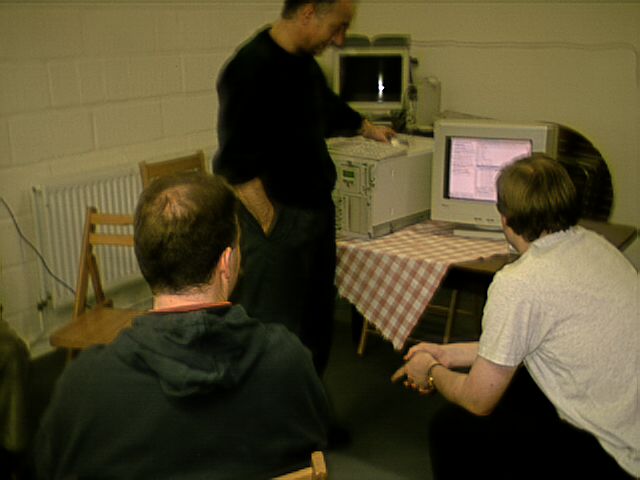
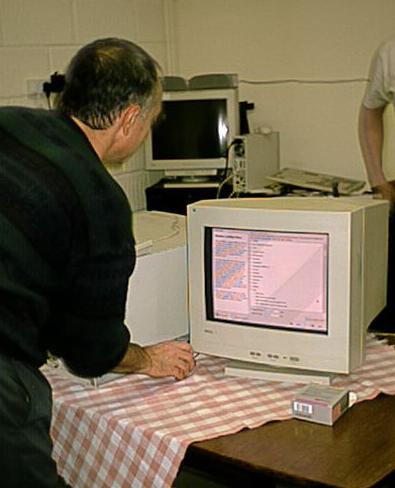
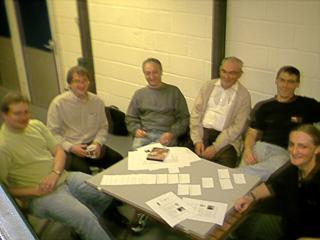
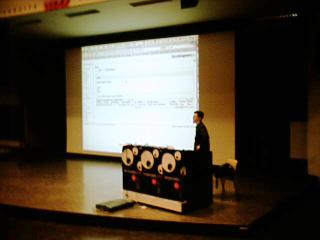
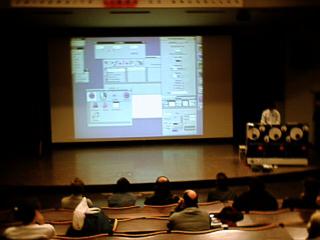
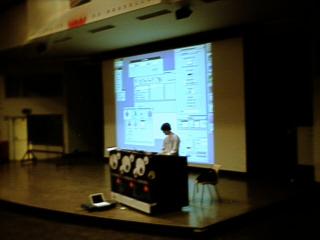
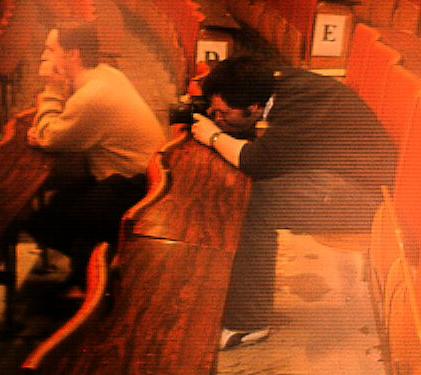
Also found a photo showing the building site at the back. Not long after they started, part of the site (3m away and 3m above a drain) flooded, stranding some materials in water. An attempt to get them with a forklift needed them to pull the forklift out with a truck. In this picture, the materials are no longer in water. They're in ice :-)

| 2004-04-08 17:52:59
Copyright and Hacking
MJ Ray <mjr@dsl.pipex.com>
I'm not sure whether it's just that I hadn't spotted it before, but the US-Aus FTA (and the danger of a US Digital Millenium Copyright import) has made Linux Australia campaign. I think many Aussies drank the "technical advantages will be enough" juice of some OSS-hardcores far too deeply. Some time ago, I was told that Australia was an example of FSF's failure to campaign convincingly. When I looked, Australia had no real FSF presence!
I've been worried for some time that the lack of an FSF-sympathetic body meant the Aussies were going to get squished by the proprietary publisher political (P3) lobbyists, but I can't do everything and Aus is a long way from here. Fortunately, as the P3 guys attack, the freedom fighters there have got organised. I wish them success. If you are in Australia, please help their campaign. Freedom to hack may depend on it.
More locally, FFII are holding another on- and off-line protest . I'm not participating online this time because the last one took a site I used offline for weeks. I had to hunt for mirrors and backups. It is not good to waste free software supporter time like that. When FFII stop talking about "close" and "block access", I will support their protests again.
Nearly had a bad thing happen to mabloss, as I confused > with | when moving blog entries around. Fortunately, I had the newly-clobbered script open in an editor, so no harm done. I uploaded a new tarball of mabloss to stop that happening again. I guess a release was needed if I was worried about losing my edit.
Music sales are down. Aren't we surprised? No. I agree with most of richdawe's comment on music - additionally, when vendors start suing their target market, it puts me off buying from them. Living in a crap FM/AM coverage area, I probably bought more recorded music before getting ADSL and satellite and getting access to a decent selection of radio stations.
That reminds me to describe the fun hardware hack. I want to be able to listen to sat radio without the tv on, so I hooked up some PC speakers (into the VCR, because the sat box's audio sockets seem to be an odd size). No power points available, so solder a 99p DC plug onto a 89p 4-AA battery holder and we have music! I am really out of practice at soldering: took 3 goes to get a good joint. Sounds good now, but I wonder how long the batteries will live. Time to read the speaker specs and do some maths.
| 2004-04-08 11:43:35
One Railway, There's only four One Railways
MJ Ray <mjr@dsl.pipex.com>
I commented on the launch of One Railway, which currently runs about four trains a day to here. I wonder whether WAGN will become "GN" now it's lost the West Anglia routes. Nah, that would be too obvious. They'll do nothing until the oft-mentioned Thameslink merge.
| 2004-04-08 10:51:05
New page, new code
MJ Ray <mjr@dsl.pipex.com>
Started a new unstable branch of MaBloss and changed its data structures. Added another page to the main blog. More later, when I've slept and can think.
| 2004-04-08 02:18:56
This website is copyright 2004 MJ Ray. All Rights Reserved. Please ask about
reproduction rights if not explicitly stated.
Some photographs are from freeimages.co.uk
DHD Photo Gallery and tsw.org.uk.
This site built in MzScheme with
Bluefish,
wily and GIMP.
*[SWN]: Scheme Weekly News